
Holiday Sale  Holiday Sale
Holiday Sale Holiday Sale
Holiday Sale Holiday SaleGive the Gift of Growing Food

Our sustainable food-growing systems allow your family to harvest fresh greens, vegetables, herbs, flowers and fish year-round.
An aquaponics home system combines a fish tank with a soil-less garden bed into one recirculating ecosystem. Fish waste feeds beneficial bacteria that convert into nutrients for your plants, and the plants filter and clean that same water before it returns to the fish. The result is a self-sustaining food production system!


AquaUrban
- 50″L x 28″W x 43″ H
- Raises 8-20 fish
- Greens, vegetables, flowers & more
- Perfect in kitchens & classrooms

Harmony
- Choose between 2-4 grow beds (dimensions vary)
- Raises up to 25 fish
- 180-720lbs of tomatoes annually
- Greens, vegetables, flowers & more

Nursery
- 2ft W x 4ft L
- Four independently controller growing tiers
- Start seeds, growing microgreens, or irrigate indoor house plants
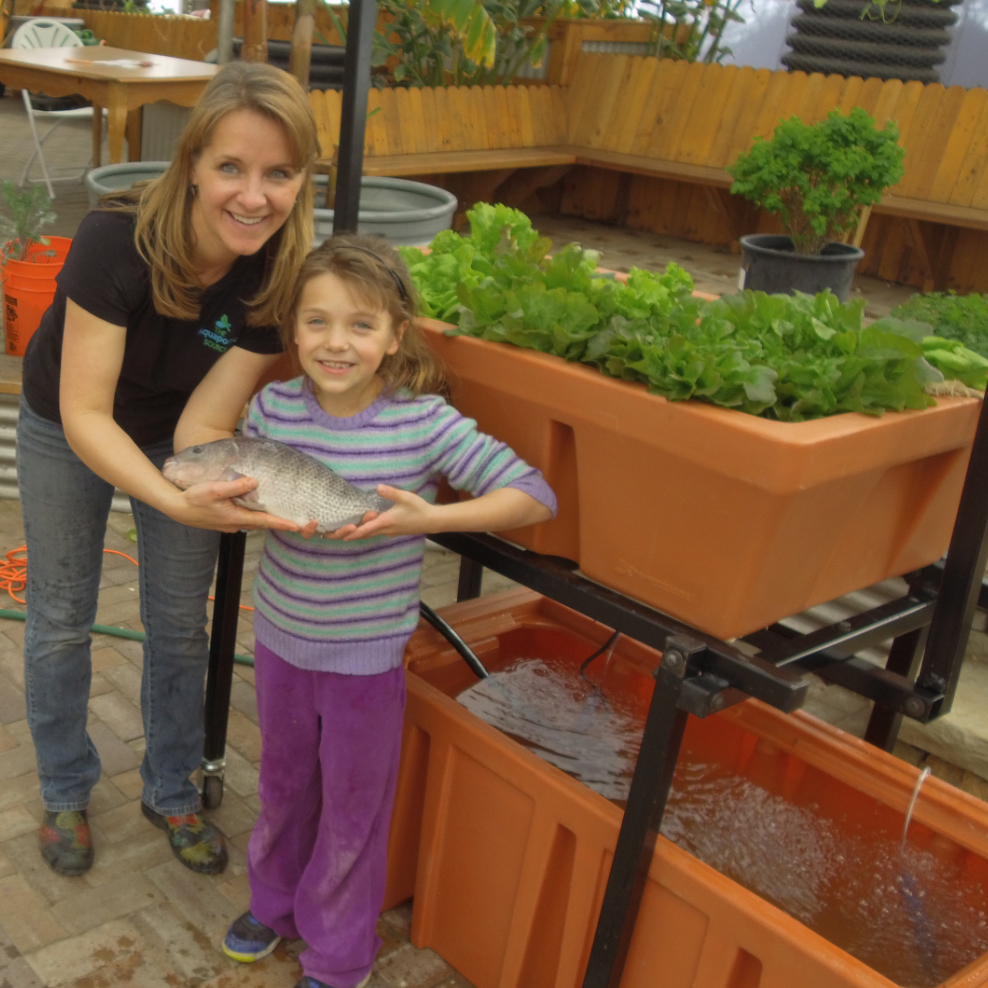

Isn’t This Just Hydroponics?
Yes! But also, no! Aquaponics and hydroponics both grow plants without using soil. But instead of adding nutrients into the water for the plants, we feed fish. It is the fish that naturally add the nutrients for us.
The beauty of our systems is that they can operate without fish. You’ll still add water and nutrients into the system but fish are not required in order for the system to grow plants. We have hydroponic nutirents that you can add to replace the fish. But fish are fun to watch grow, are a sustainable growing method, and double as an edible protein menu option.
Home grown fish tacos, anyone?


Edible or Ornamental Fish
Do you have to harvest your fish? No.
Can you harvest your fish? Yes!
Several different species of fish can be raised such as:
Tilapia – Hybrid Striped Bass – Catfish – Trout – Koi

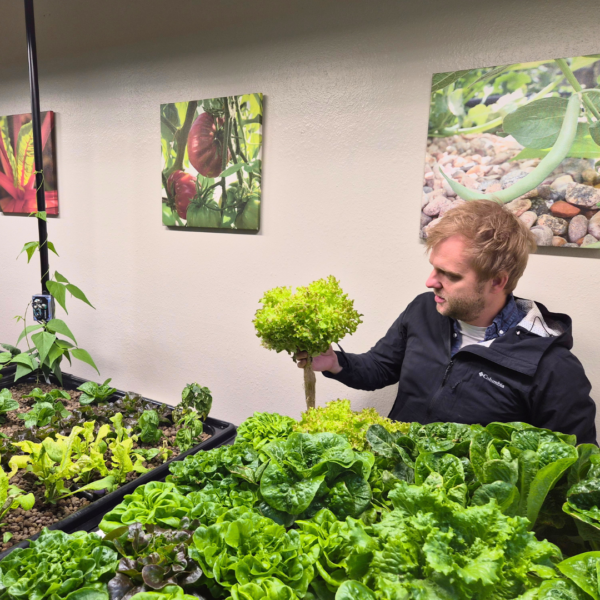

The clay pebbles provide a stable medium for the roots to grow and absorb water and nutrients. In addition to leafy greens like lettuce, basil, and kale, media beds are particularly great for growing a wide variety of fruiting and vining crops, such as:
Tomatoes – Peppers – Eggplant – Beans – Squash-Cucumbers – Strawberries – Dwarf Fruit Trees
Lettuce varieties
Romaine – Bibb – Salanova – Butterhead – Baby Greens
Herbs
Basil – Parsley – Mint – Thyme – Rosemary – Cilantro
Cooking Greens
Collards – Mustard – Kale – Chard – Bok Choy


AquaBundance Modular Systems
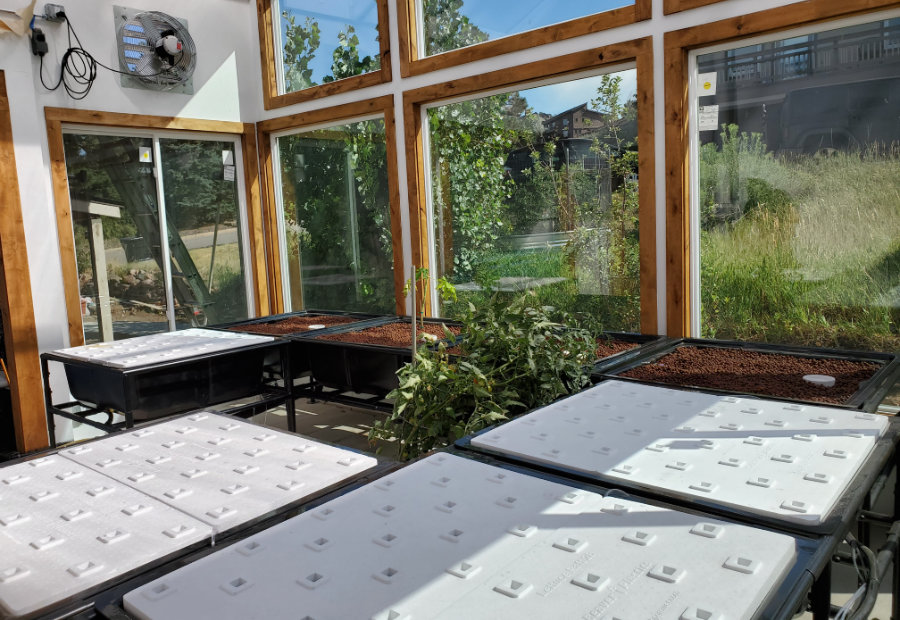
Our AquaBundance Modular Systems are great for larger rooms and greenhouses. Systems can be configured with as few as three grow beds all the way up to eight. Both media and deep water culture grow beds can be combined. Custom paneling and powder coating colors are available to best match your style.
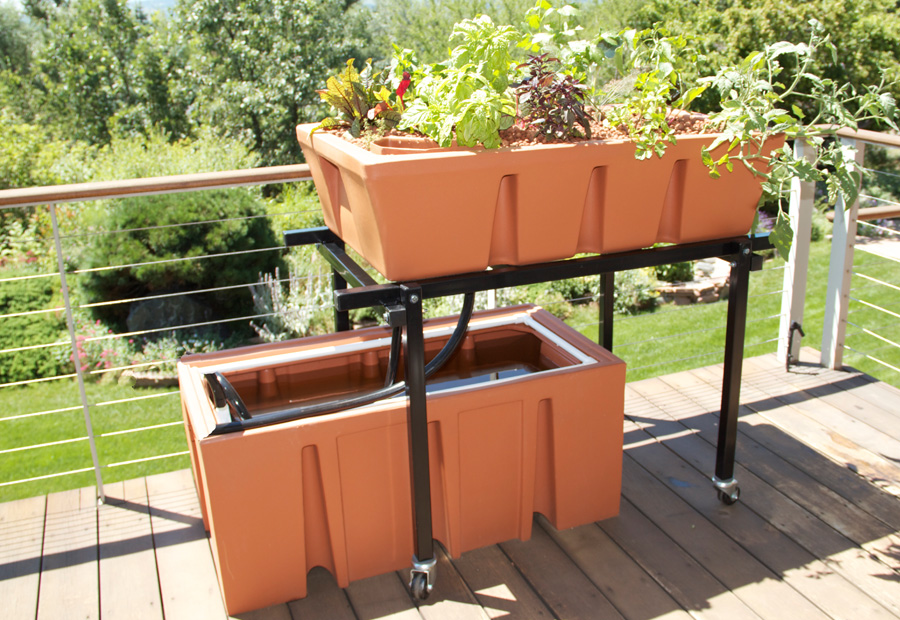
The AquaUrban System
Our AquaUrban Aquaponic System is our most popular system. This compact and beautiful garden kit comes with optional wheels for easy mobility. Larger edible size fish can be raised along with a wide variety of crops in the 2′ x 4′ media filled grow bed. Great for maximizing growth in a small space!
The Harmony System
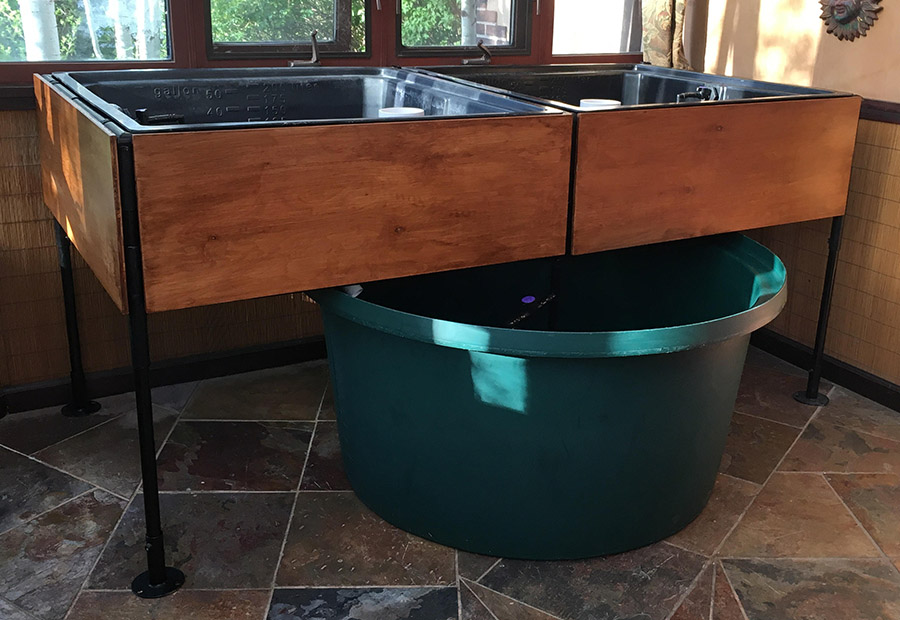
Our Harmony Systems consists of two media beds and a single 125-gallon fish tank which is constantly circulating nutrients to your plants. Media beds are great for a diverse variety of crops. The Harmony System includes all plumbing, powder coated steel frame, and optional exterior paneling.
Want for more info on how to maintain your new aquaponic system? We offer a variety of classes packed with all the information you need to keep your system healthy and balanced.
LETTUCE VARIETIES
Lettuce Varieties
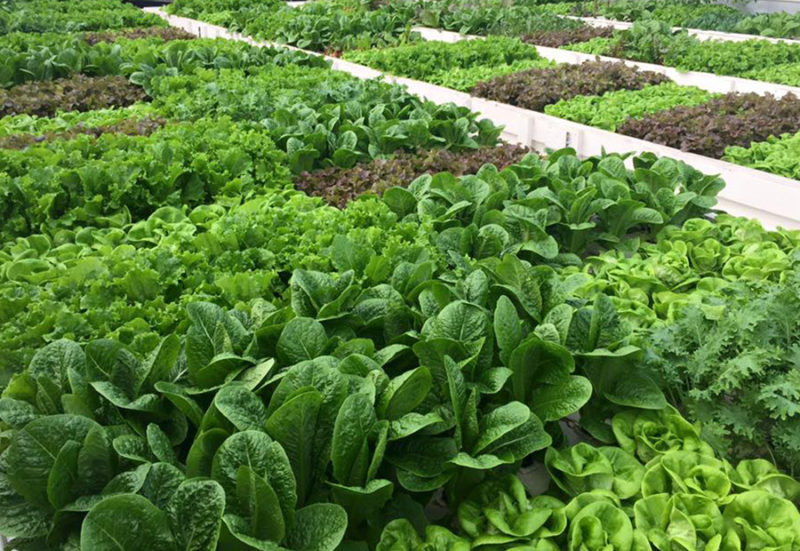
Romaine, Bibb, Green Star, Red Oak Leaf, and Salanova lettuces are among our favorites for home systems.
HERBS
Herbs
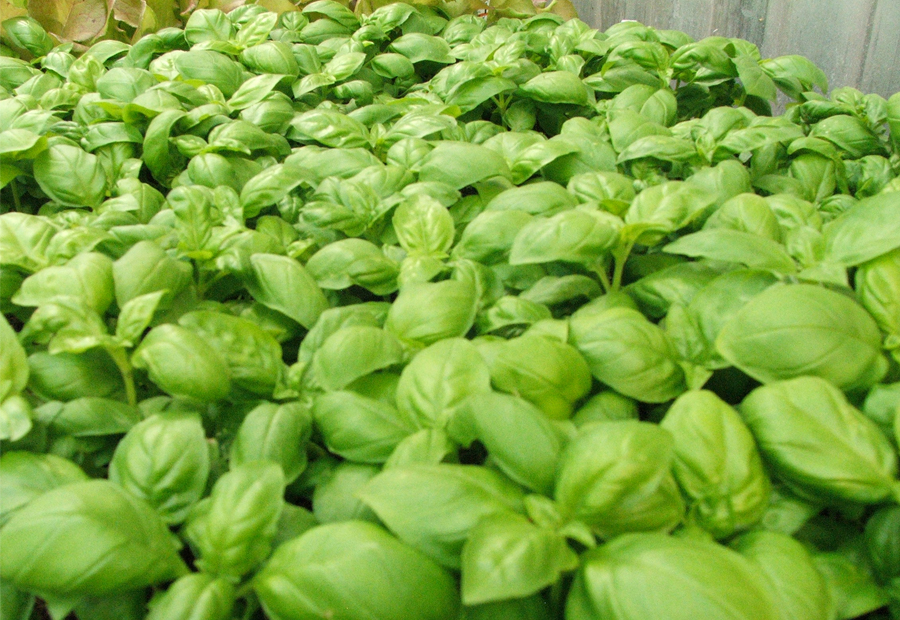
Both perennial and annual herbs grow rapidly in aquaponics systems. Basil, Cilantro, Mint, Parsley, Oregano, Dill, Stevia, and Thyme are just a few that we like to grow.
FRUITS
Fruits
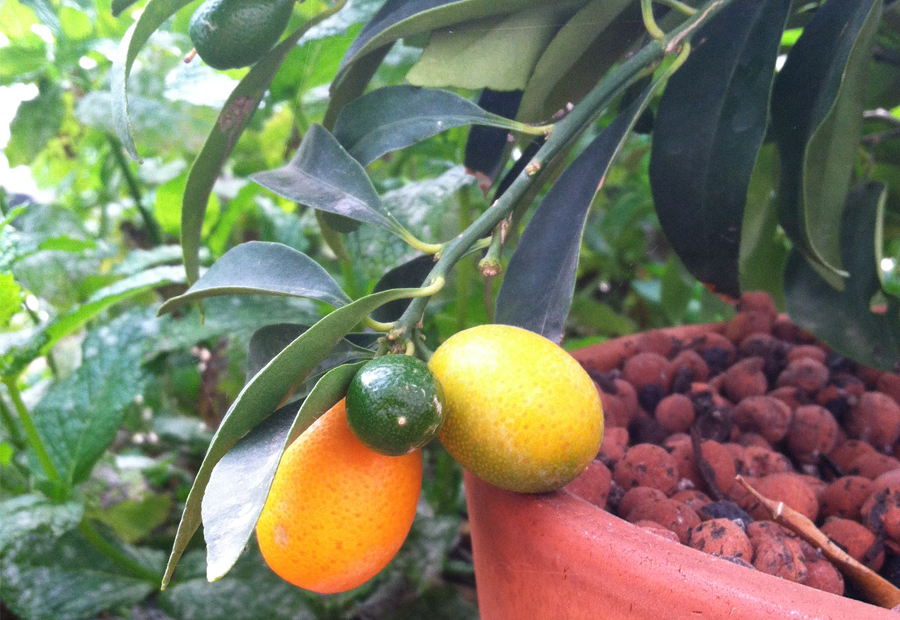
Most fruits are perennials, which will take up a lot of space in your aquaponics system. Strawberries, Lemons, Limes, Figs, and Kumquats are some of the fruits we have grown in our systems.
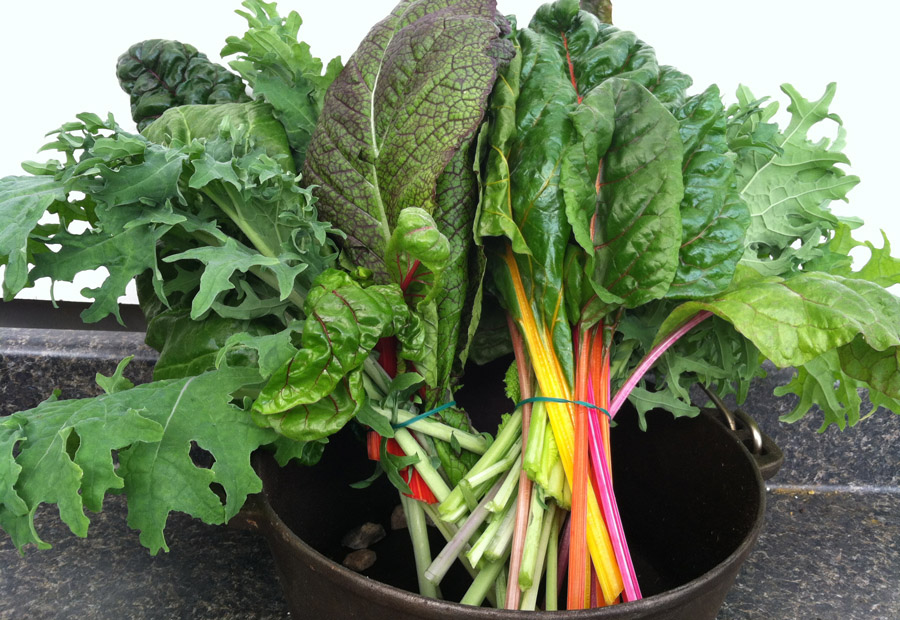
GREENS
Greens
What kinds of greens do you prefer? They all grow well in our systems, including Kale, Swiss Chard, Mustard Greens, Collards, Tatsoi, and Bok Choi.
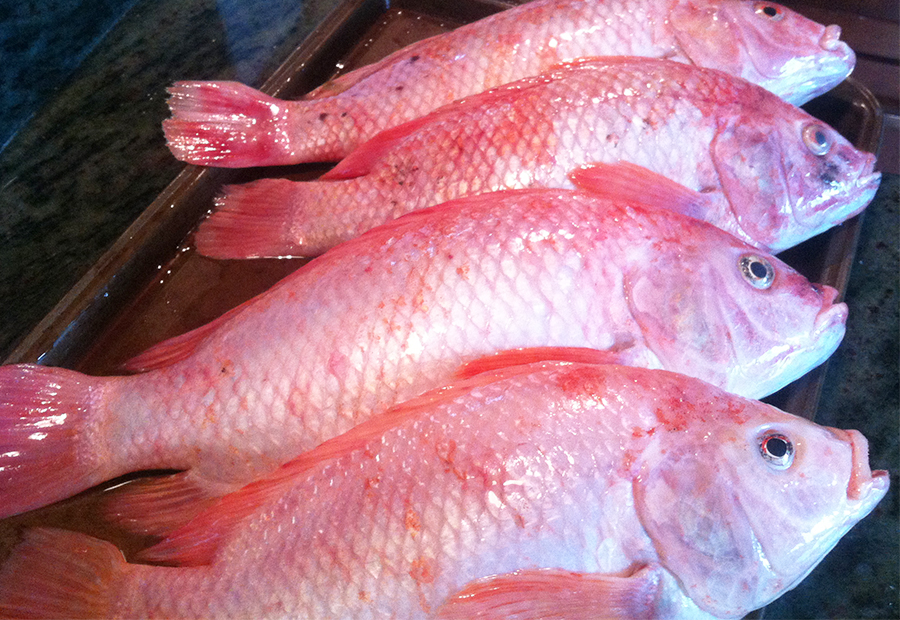
FISH
Fish
A wide variety of freshwater fish species will adapt well to aquaponic systems. We have had great success with Tilapia, Hybrid Striped Bass, Trout, Yellow Perch, Catfish, and Koi.
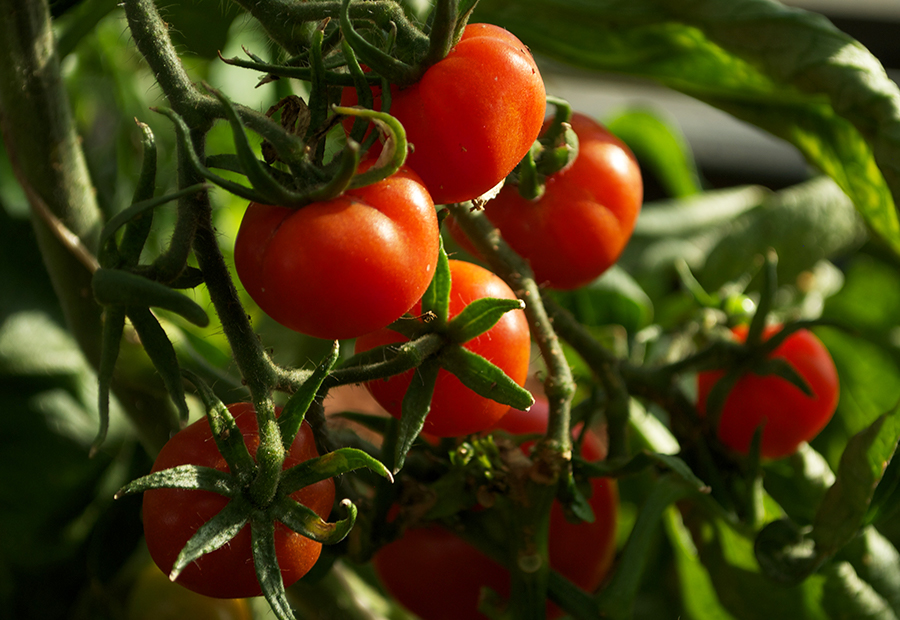
VEGETABLES
Vegetables
Many vegetable varieties may require additional nutrient additives during fruiting periods, but we find it’s well worth the extra attention to pick fresh Tomatoes, Peppers, Cucumbers, Squash, Eggplant, and more, right out of your home system.
Buying fish for your aquaponic system can happen with any reputable in- or out-of-state vendor. Many vendors will ship fingerlings out of state across the continental U.S. with a 24 – 48 hour oxygen supply for the fish. This means your options expand beyond a drive to the local pet store or trying to find a vendor in your state. Please check with state and local municipal regulations related to permissible fish species and what paperwork or licensing might be needed before purchasing.

Yes! Our newsletter is released quarterly and features exclusive deals, farm updates, industry news, & so much more! Just enter your email below to enter our mailing list.
A properly designed and maintained aquaponic system should not produce any foul smells. When growing fish, you can expect a slight odor, but it should not be offensive. If you have an effective fish waste solids management system (meaning an adequate bacteria population and/or mechanical solids filtration) you should not expect your system to be very smelly. A healthy, aerobic (oxygenated) aquaponic system is what we strive for, and will not smell any more than the smell of a healthy soil garden. Anaerobic zones (oxygen-lacking) within the growbeds, pipes, or other areas of your aquaponic system will cause a foul, sulfur smell. It will be necessary to unclog any anaerobic zones and possibly add air stones to the area to keep the system healthy and odor-“less”.
Often a dead fish in your tank may be the culprit of a foul smell, so be sure to check in on your fish frequently and ensure that you have easy access to the fish tank.
There are fish species that can tolerate low temperatures, Koi can manage to overwinter in below freezing temperatures outside. Trout and salmon are other species that prefer colder temperatures. Most other fish species will not survive outside through a freeze, so be sure to check the temperature range of the fish you intend to grow.
Both plants and bacteria cannot survive temperatures around or below freezing (0°C – 32°F), so growing outdoors through the winter isn’t feasible without a greenhouse to keep extreme temperatures regulated. Without bacteria, you can expect ammonia levels to build up in your tanks, eventually killing your fish.
Yes! Because fish are cold blooded animals their waste does not, and cannot, contain either of these pathogens. In fact, there was a recent study done by the College of Tropical Agriculture in Hawaii titled “A Preliminary Study of Microbial Water Quality Related to Food Safety in Recirculating Aquaponic Fish and Vegetable Production Systems” that explored this very question and concluded that in general aquaponically grown food is even safer than soil grown food! Click the link above to read the report of the study findings.
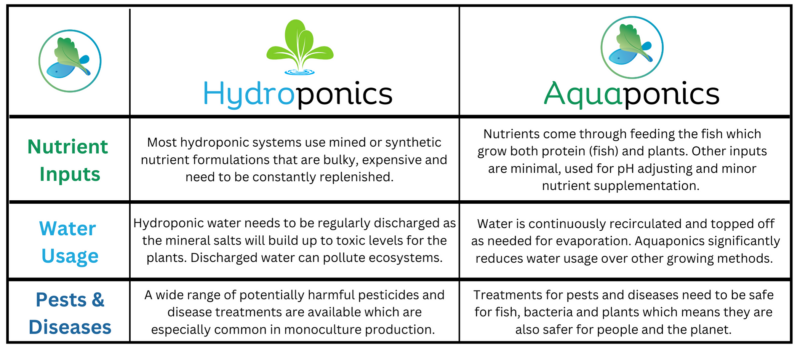
While they are both soilless growing techniques, aquaponics differs from hydroponics in many significant ways. The biggest difference; in aquaponics, the fish provide the nutrients for the plants, where in hydroponics, the plants grow from synthetic nutrients added to the water. For more information, visit our What Is Aquaponics? page.
Absolutely.
In fact, it doesn’t work unless it is organic. The entire system is connected, so trying to fix an issue for one part of your aquaponics system will affect the whole thing. Adding chemicals, antibiotics, or other artificial additives to your aquaponic fish tank would eventually end up harming your plants. If you use pesticides or growth stimulants to aid your plants, it will harm your sensitive fish. Every element that you add to your system must be plant-safe, fish-safe, and definitely nothing that’s anti-bacterial!
In terms of official USDA Organic Certification, commercial aquaponic farms are eligible to be certified. There are strict standards that farm managers must follow, which regulate nutrient additions, pesticide use, food safety, and other aspects of farm operations. For more information, reach out to your local organic inspector.
There are many benefits to growing your food with aquaponics. Remember that aqua stands for aquaculture – raising fish. Ponics – in Latin means to work. Hence, you are putting your fish to work, growing plants! Here are some of the benefits of growing with aquaponics.
- Aquaponics is Sustainable – From efficiently using precious water resources, to producing no waste, aquaponics is sustainable in so many ways. Check out our blog, “7 Ways Aquaponics is Sustainable” for the full run down.
- Aquaponics can be used anywhere – While soil is immensely valuable in growing gardens, there are places which have very poor soil or no soil at all. Sand, heavy clay, asphalt or concrete, soil contaminants or rocky terrain make it difficult if not impossible to grow. Aquaponics, however, allows growing in a wide variety of places. It can be built on parking lots, rooftops, backyards and basements. It allows for growing indoors or outdoors. In addition, Aquaponics can grow year-round where ever you can control the temperatures. Here are some of the benefits of growing with aquaponics.
- Aquaponic is local – It doesn’t get any more local than growing food in your home, school, or small community farm. Most food travels thousands of miles to get to our plates and by the time it arrives it has lost much of its nutritional value. Why not grow more of our produce and protein locally to help the environment.
- Aquaponics is Organic – Growing your own vegetables, fruits and herbs will provide you the most nutrient dense food possible. Aquaponics is a natural ecosystem without any harmful chemical fertilizers and pesticides used in commercial agriculture. Feel confident that you know exactly what’s in the food you’re eating because you grew it yourself!
- Food Security – Food independence and security is increasingly important in these changing times. Aquaponics is one way of living a more self-reliant lifestyle. By adding in solar powered systems and energy-conserving building practices, we can start to see the possibility for everyone to grow their own food.